
Supporting struggling math students in 5th grade takes intentional planning, especially in diverse classrooms where students may be working below grade level or learning English.
Whether you’re teaching at a Title 1 school or have a range of ability levels in your class, using targeted math intervention strategies can make all the difference. In this post, you’ll find practical ideas to differentiate instruction and help every student succeed in math.
1. Use Color Coding to Clarify Math Concepts
Color coding is a simple yet powerful tool, especially in math. When modeling math problems on your whiteboard or Viewboard, use different colors to show various steps or problem types.
For example:
- Use blue to show problems that involve dividing the numerator to get equivalent fractions.
- Use green to indicate when you’re dividing by 10.
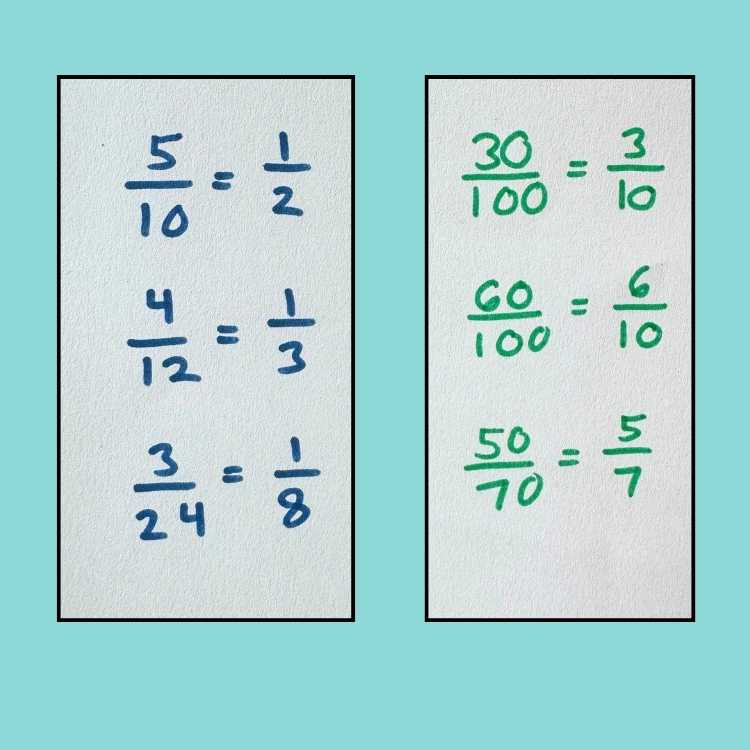
Color Coding in Fraction Models
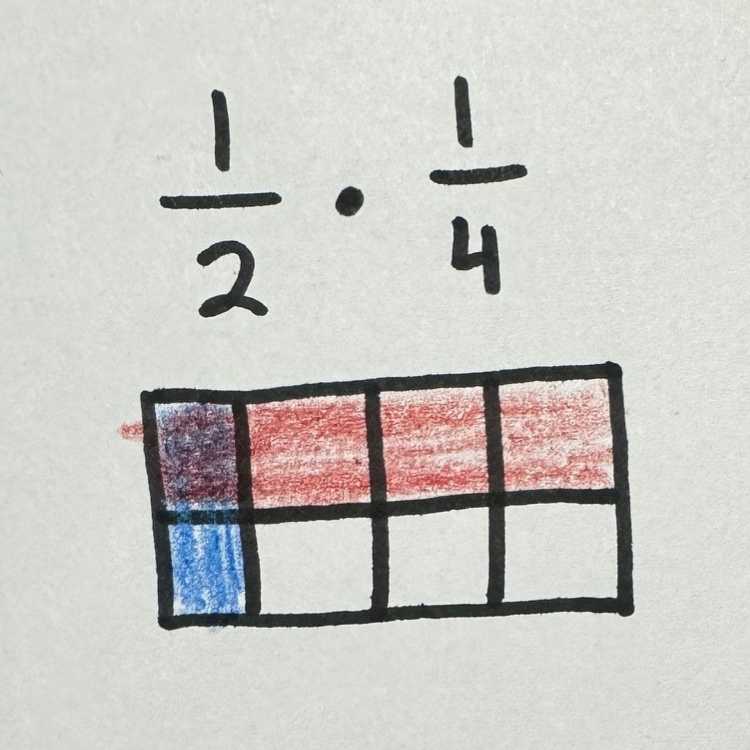
Color coding is especially helpful when teaching fraction concepts like multiplication. When teaching ½ × ¼, draw ¼ in one color and ½ in another.
I will even color 1/4 and 1/2 separately (right image) so they see that both fractions are on top of each other. Where you see two colors is the answer to the problem: 1/8.

2. Start New Math Concepts with Simple Numbers
When you start teaching a new concept, keep your examples and problems simple. For example, on the first day you are teaching how to change an improper fraction to a mixed number, use single-digit numbers.
You shouldn’t give students an improper fraction like 143/6. That can be for later lessons when your students have a solid understanding of how to do the problem. Textbooks often include challenging problems on the first day of instruction.
Start with teacher-made problems that are simple, then gradually increase the complexity as your students’ understanding increases.

3. Modify Assignments for Intervention Students
Has this happened to you? You are teaching a new math concept. You have shown examples, and you and your students have done a bunch of practice problems together.
They seem ready to complete independent work from the textbook. When you assign it, you see your intervention students struggling with problems that are way too difficult for them.
Seriously, who do these publishers hire to write these math problems? Always take a look at the problems students will complete during their independent work in advance.
Skip any problems that are way above the level of your intervention students. Instead of pointing out who’s doing different work, call those students up to your small group table, or walk over to where they are sitting. Frame it positively: “I only want you to do these problems” instead of “Don’t do these”.
4. Show an Example of How to Do Problems for Assignments
When you give an independent assignment to your striving students, always do a few examples together. Aim for 3.
Intervention students often have anxiety about completing assignments and need the confidence to get it done. When you do a few examples in math, especially, it lowers their affective filter. Students will see the pattern to solve those problems.
5. Provide Visual Models for Complex Concepts
Fractions
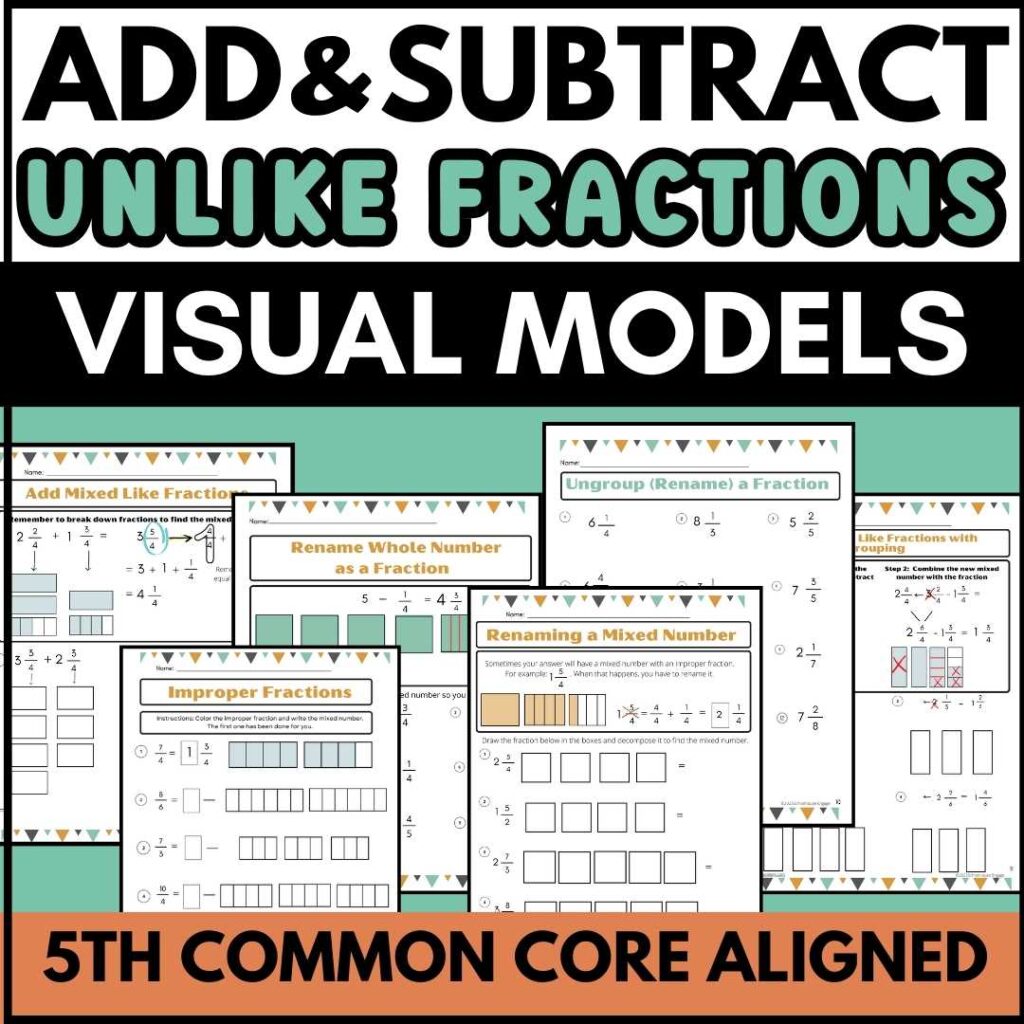
Fractions are a big deal in 5th grade. There is so much to it. Intervention students need a lot of visual models to help them understand how to:
- Change an improper fraction to a mixed number and vice versa
- Find a common denominator when adding and subtracting unlike fractions
- Subtract mixed numbers with regrouping
- Add like fractions that result in a fraction greater than one
- Multiply a fraction by a fraction
- Multiply a unit fraction with a whole number
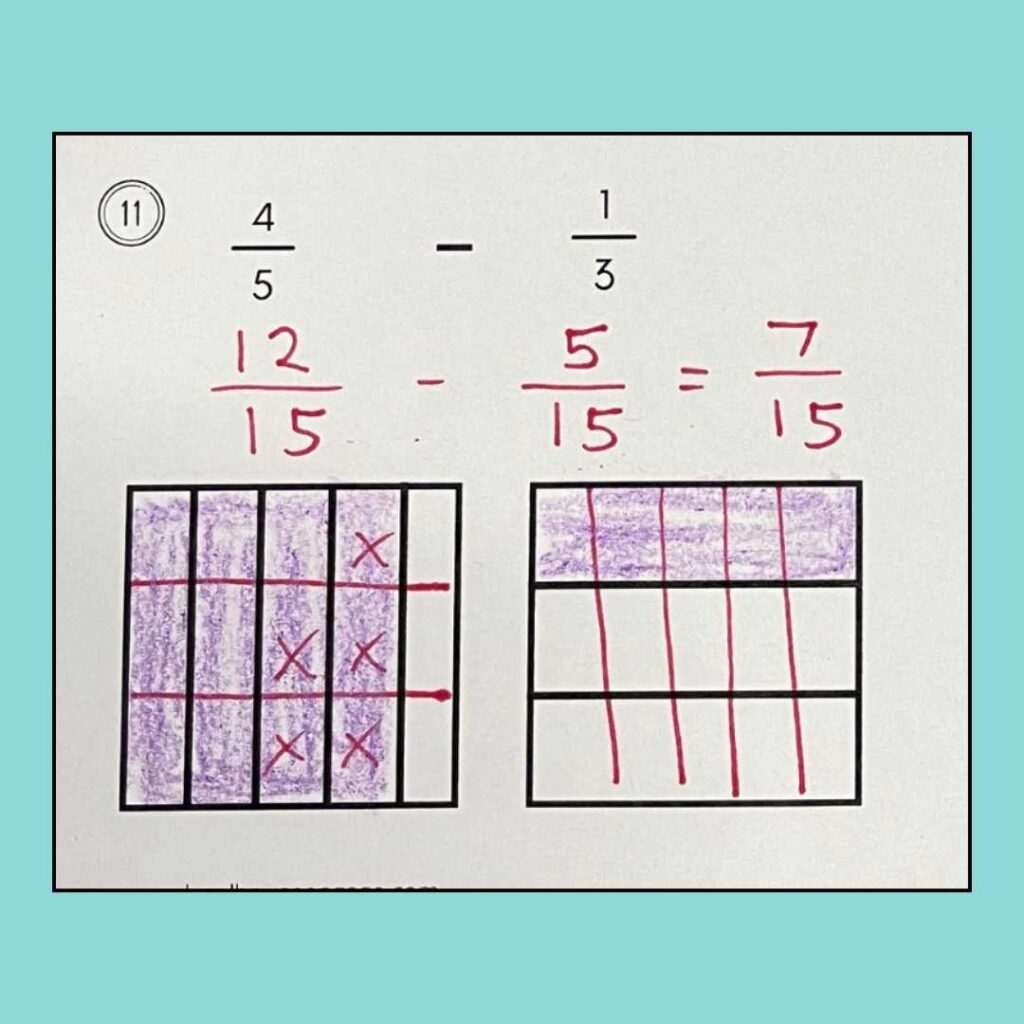
Before you move into solving equations with only numeric representation, make sure your students know how to solve problems with visual models.
To read more about how I teach my students to add and subtract unlike fractions with visual models, read my other blog post.
Long Division
Educators who still teach the standard algorithm without teaching students the true meaning of long division with base tens blocks are making a huge mistake.
Level the playing field and teach all your students first the meaning of long division by using the area or box method and base tens blocks.
Don’t have base ten blocks? Get this divide with base tens blocks worksheet below. Once students get the practice, just draw the base tens blocks.
Are you unfamiliar with how to do long division with the area/box method using base ten blocks? In this video, I explain exactly how to do it in layman’s terms.
Once your student understands how to divide with base tens blocks, move on to teaching the algorithm or “shortcut”.
If the shortcut is developmentally out of reach for your intervention students, then they always have the area or box method to go back to. Read my blog post to learn how to do the area/box method visually using base ten blocks drawings.
The box method uses the same steps as the partial products method, but it looks different. In my experience, it’s best to choose the method you are most comfortable teaching and stick to one when teaching your intervention students.
Often, students who struggle with algorithm problems can solve the same problems if they draw them out. Let your students know that that is always an option. It doesn’t matter how they solved the problem; what matters is that they get it right!
6. Use Math Mnemonics to Aid Memory Retention
Mnemonics are a great way to help your intervention students remember the steps to solve problems. I’ve written a whole article about some tried and true mnemonics I’ve heard and invented throughout the years. Click HERE to read.
It can be frustrating working with striving learners who seem to just not “get” what you teach. But with a few modifications and creativity, they will progress.
7. Review Math Concepts Daily
Struggling math students need daily review. Include daily questions that review past material in your math lesson.
You can do a “warm-up” before your actual lesson by quickly writing math problems on the board. Most math publishers will have a “Review” or “Remembering” worksheet. Use it!
A great alternative to fraction review worksheets, are these fraction cards or tents that students can use daily. There are differentiated with a beginning and advance level. You can learn more by reading, Quick & Easy Fraction Review: A 5-Minute Alternative to Worksheets.
With the right support, all students can make progress. Math doesn’t need to be a struggle. Work with your students at their level and focus on simple problems so that they feel successful. You got this! Giselle