
Adding and subtracting mixed numbers with unlike fractions is one of those math concepts that can quickly become confusing for students.
It’s not that they can’t do the math—it’s that there are so many steps involved! Between finding a common denominator, converting mixed numbers, regrouping, and simplifying, it’s easy for students to get lost along the way.
If your students are struggling during this unit, you’re not alone. The good news is that with the right strategies, we can make this skill clear and approachable for every learner.
By the way, before students can confidently add or subtract unlike mixed numbers, make sure they’ve mastered problems with like fractions.
When denominators are the same, students can focus on combining whole numbers and fractional parts without worrying about equivalent fractions. Once that foundation is solid, introducing unlike denominators becomes much smoother.
1. Keep It Visual
Before you begin teaching the procedures, students need to see what’s happening when we add or subtract mixed numbers. Visual fraction models—like bars—help students understand that when denominators don’t match, the pieces of the fractions aren’t the same size.
I like to start with simple visual comparisons:
- Draw two rectangles showing ½ and ⅓.
- Ask: “Can we add these right away?”
- Guide students to realize the pieces “speak different languages”—and that’s why we need a common denominator.
Once they understand why we need common denominators, the procedural steps make a lot more sense.
2. Two Main Methods to Teach
There are two main ways to teach adding and subtracting mixed numbers with unlike fractions:
Method 1: Convert to Improper Fractions
This is the more traditional approach. You first change each mixed number into an improper fraction, find a common denominator, perform the operation, and then simplify back to a mixed number.
This method is faster and should be used once students are confident with fractions. However, it’s best for your more advanced learners who are already fluent in finding equivalent fractions and switching between forms.
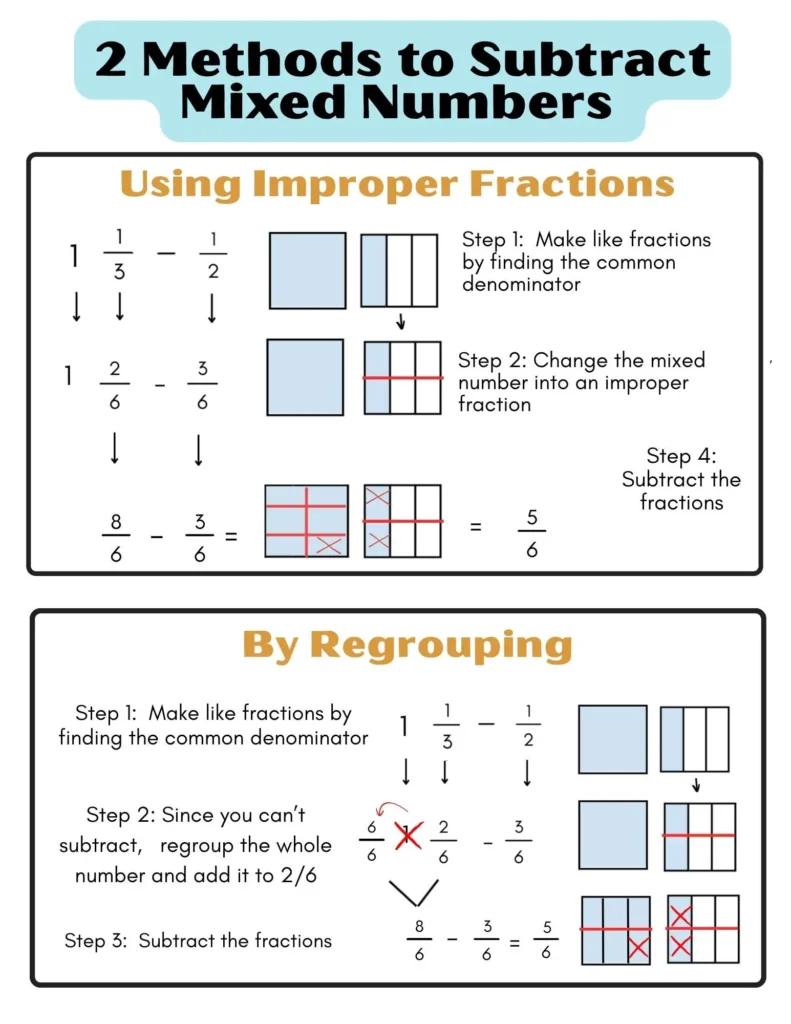
Method 2: Regrouping or Decomposing the Fraction
For most students, especially those who struggle in math, regrouping is much more intuitive. Instead of turning everything into improper fractions, they break apart the mixed numbers and work with the whole numbers and fractional parts separately.
Students can first model or draw the fractions to visualize them. Then they can use equivalent fractions to make the denominators the same, regroup if needed, and combine.
This method allows students to see what’s happening—especially when you let them draw the fractions. It helps them build a conceptual foundation rather than memorizing steps.
3. Know Your Learners
One of the biggest mistakes teachers make is showing both methods too soon. When students are already unsure, introducing multiple strategies can lead to even more confusion.
Here’s what I recommend:
- Start with regrouping and visual models for your whole class.
- Once your advanced learners are fluent, introduce the improper fraction method in a small group setting.
This keeps struggling students focused on one clear, visual method while allowing your high-achieving students to explore more efficient shortcuts later on. This is what differentiation is all about!
4. Scaffold the Practice
When students first begin, make sure the problems are scaffolded:
- Begin with like denominators.
- Move to unlike denominators where regrouping isn’t needed.
- Then, gradually (possibly the next day), include problems that require borrowing or renaming.
If you notice frustration, slow down and bring back the models. Simple drawings can do wonders.

5. Reinforce with Practice That Builds Confidence
Consistent, well-structured practice is key. Instead of lengthy worksheets, I like to give students short, focused practice sheets that target one skill at a time—such as finding common denominators, drawing fraction models, or regrouping mixed numbers.
That’s exactly why I created my Adding and Subtracting Unlike Mixed Numbers worksheets with visual models.
These worksheets include:
- Visual fraction models to help students understand what’s happening.
- Step-by-step problems that scaffold the process.
- Space for students to draw, decompose, and regroup fractions.

If you want to make adding and subtracting mixed numbers simple to understand, you can find these worksheets in my Teachers Pay Teachers store, Schoolhouse Engage.
Final Thoughts
Adding and subtracting unlike mixed numbers are probably the most cognitively challenging math problems your students will encounter when it comes to fractions. When you start with visuals, keep your methods simple, and give students opportunities to practice with support.
Remember, math understanding builds over time. With patience and the right resources, your students will understand how to solve these complex problems.
For more blog posts about fractions for upper elementary, be sure to read Mastering Mixed Numbers & Improper Fractions: Visual Strategies for 5th Grade and Teaching Adding and Subtracting Unlike Fractions with Visual Models.